

Read Time:
8
Minutes
Industry Trends & Future Tech
August 4, 2026
How Telecom Data Analytics is Reshaping Network Operations in the 5G Era
The UK’s telecommunications industry is generating more data than ever before. Billions of network events, customer interactions, and infrastructure signals flow through operator systems every hour, yet for many operators, that data remains locked inside ageing OSS/BSS platforms, inaccessible to the people who need it most. As 5G rollouts accelerate and customer expectations rise, the ability to turn network data into real-time intelligence is fast becoming the difference between operators who lead and those who fall behind.
The telecommunications industry is at an inflection point. For decades, network operations relied on reactive models: fault detected, alert raised, engineer dispatched. That model was adequate when networks were simpler and data volumes were manageable. Neither condition holds in 2026.
This report sets out what analytics-driven network operations looks like in practice, where UK operators are investing, and what the implications are for business leaders navigating 5G rollout, OSS/BSS transformation, cybersecurity obligations, and cloud migration programmes.
The analysis draws on the latest data from Ofcom, the NCSC, TM Forum, GSMA Intelligence, and Gartner, and reflects Ntegra's direct delivery experience with telecoms clients including Vodafone, Connexin, and Amdocs.
Why operators can no longer afford to be data-passive
The competitive and operational case for embedding analytics at the heart of network management.
For decades, network operations ran on a reactive model: an issue emerged, an alert fired, an engineer investigated. That approach was serviceable when networks were simpler, and customer tolerance for downtime was higher. Neither condition holds today.
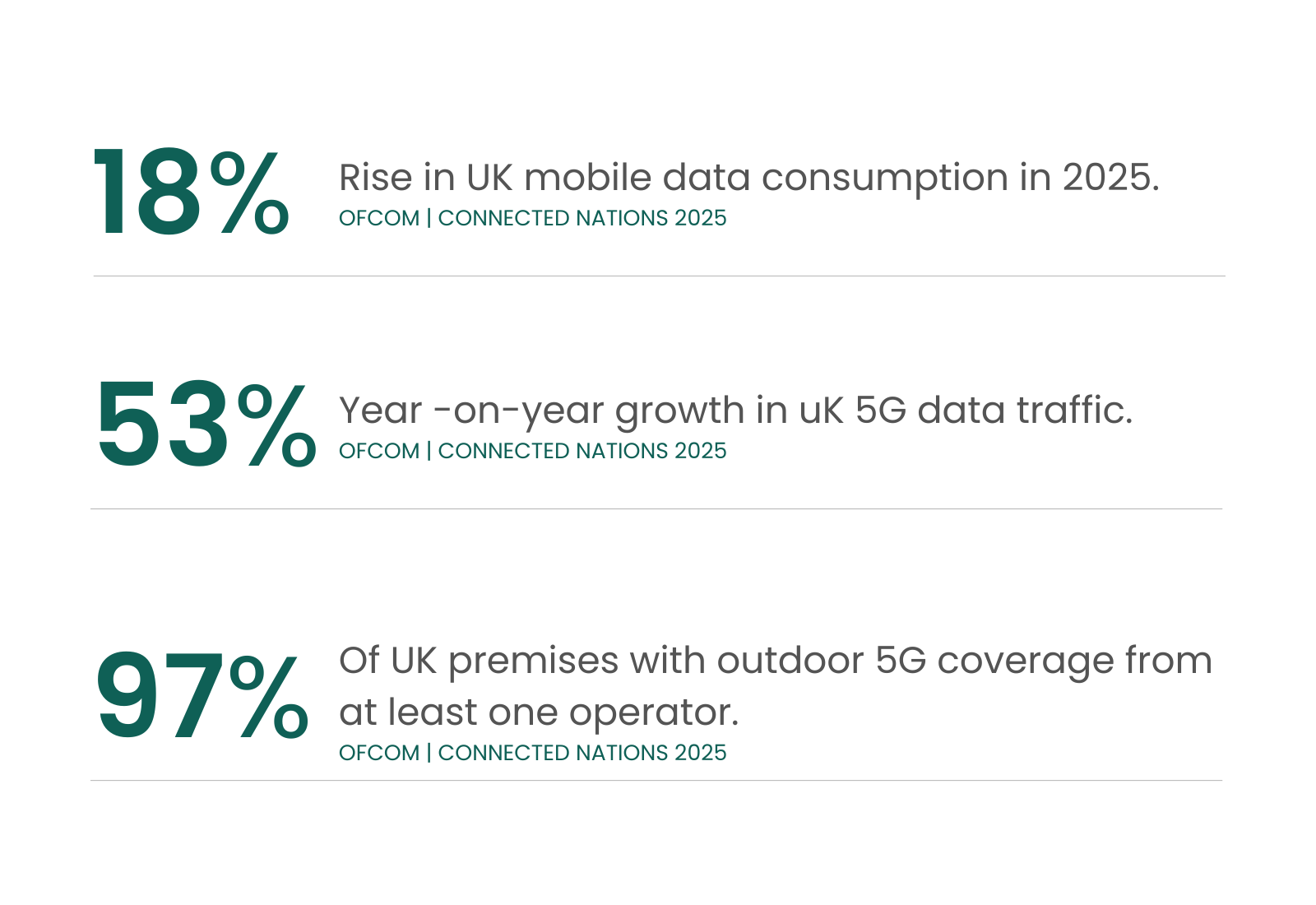
Ofcom's Connected Nations 2025 report confirms the scale of the challenge facing UK operators: mobile data consumption rose 18% in a single year, reaching over 1.2 billion GB per month, while 5G traffic alone grew by 53%.[1] Legacy OSS/BSS systems, designed for a different era, cannot process the volume, velocity, or variety of data these environments produce. The result is operational blind spots, slower fault resolution, and missed commercial opportunities.
"The UK's demand for data continues to grow as we live increasingly connected lives. The race to deliver the UK's full 5G future is on."
Natalie Black, Group Director for Infrastructure and Connectivity, Ofcom
The business case for investment in telecom data analytics is compelling on multiple fronts. Faster fault resolution reduces customer impact and cuts the cost of incident management. Predictive analytics can identify deteriorating network conditions before they cause outages. At a commercial level, analytics-driven capacity planning and customer insight directly improve margin and reduce churn.
GSMA Intelligence's most recent survey of network technology executives found that 85% of operators now list operational excellence (OpEx) efficiency as a primary objective for AI deployment in their networks.[2] Operators that embed intelligence across their operations can respond to changes faster, make better investment decisions, and deliver a more consistent customer experience. Those who cannot are increasingly exposed.
Key Use Cases for Telecom Data Analytics
Where analytics create measurable value across network, commercial and platform operations.
Network performance and fault management
Real-time analytics platforms allow operators to monitor network performance across thousands of nodes simultaneously, detecting anomalies as they emerge rather than after they escalate. Machine learning models trained on historical fault data can identify the signatures of impending failures and trigger automated diagnostics before customers are affected.
TM Forum research indicates that operators implementing AIOps frameworks achieve a 60% reduction in mean time to repair (MTTR) and a 40% reduction in service outages.[3] When intelligent alerting surfaces the probable root cause alongside the alert itself, engineering teams can bypass manual investigation and move directly to resolution.

Ntegra Case Study
Ntegra's OSS/BSS integration work with Connexin demonstrates agile, technically rigorous delivery in practice. Working with the fast-growing ISP to modernise their network operations platform, the project involved building a scalable, integration-rich environment capable of supporting Connexin's rapid expansion — the kind of delivery that analytics-driven network operations depends upon. Read the full case study here.
Capacity planning and 5G rollout optimisation
Data analytics transforms capacity planning from a largely intuitive exercise into a data-driven one, using demand forecasting models to identify where network investment will deliver the greatest return. Ofcom's Mobile Matters 2025 report shows that 28.3% of all UK network connections were made over 5G in the year, up 8.8 percentage points from 2024.[4] Analytics helps operators close coverage gaps, model traffic growth, and support more precise rollout sequencing.
Edge computing extends this further, enabling data to be processed closer to the source to reduce latency and unlock near-real-time services. Ofcom notes that 5G Standalone now accounts for nearly a third of total UK 5G traffic — operators investing in analytics-driven rollout will be better placed to capture the full performance advantage 5G SA delivers.
Customer experience and churn reduction
Churn drivers are often visible in the data long before a customer leaves. Usage patterns, service quality metrics, and network experience data can all be analysed to identify customers at elevated risk of switching, giving operators the window to intervene with targeted retention activity.
Linking network quality metrics directly to customer satisfaction scores creates a feedback loop that many operators have historically lacked. When engineering teams can see how network events translate into NPS impact, investment in network improvement becomes far easier to justify commercially.
OSS/BSS transformation through modern data platforms
In many organisations, OSS and BSS systems have accumulated over decades — layered, siloed, and increasingly misaligned with the data volumes and integration demands of modern operations. BT Group and Vodafone UK are both actively investing in cloud-based OSS/BSS platforms as part of wider 5G infrastructure programmes.[5]
TM Forum research indicates that only 25% of communications service providers currently feel equipped to leverage advanced AI techniques, and just 16% are confident in using AI to optimise costs and ROI.[6] Gartner projects that by 2027, over 70% of new telecom OSS/BSS workloads will be deployed on cloud-native architectures.[7] Agile delivery, iterative and stakeholder-aligned at every stage, is essential in environments where requirements evolve and the cost of getting it wrong is high.
Telecom Cybersecurity in the Age of 5G
Understanding the threat landscape and what robust security looks like for UK operators in 2026.
Why 5G expands the attack surface for operators
5G introduces a more distributed, software-defined network architecture and with it a considerably larger attack surface. Where previous generations of mobile networks relied on purpose-built hardware, 5G virtualises core network functions across commodity infrastructure, integrates with cloud environments, and connects an exponentially larger number of devices and services.
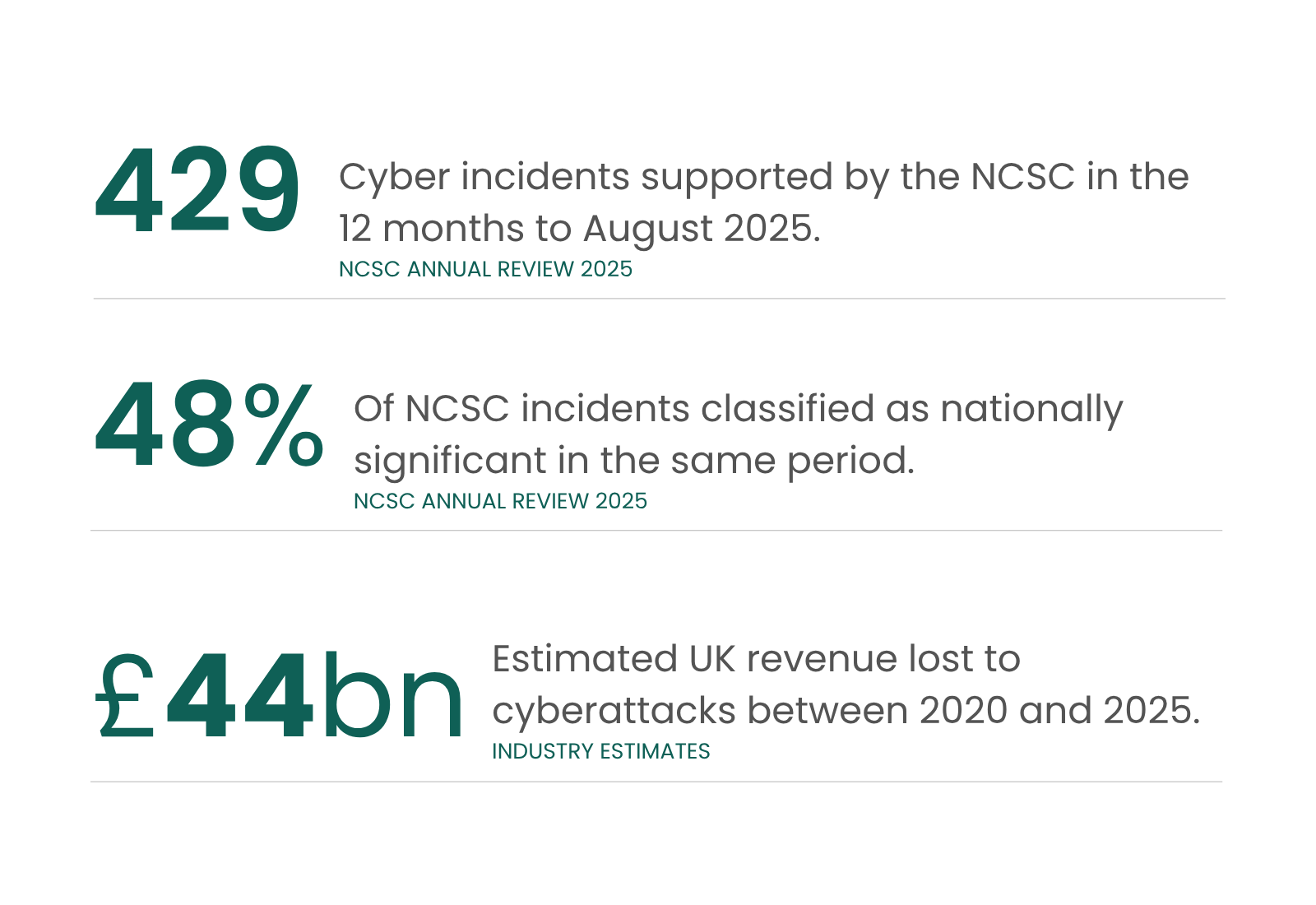
In its Annual Review 2025, the NCSC confirmed that the cyber threat to UK critical national infrastructure remains high, with telecoms networks a prime target for both financially motivated criminal groups and hostile state actors.[8] In the twelve months to August 2025, the NCSC's incident management team supported 429 cyber incidents, with nearly half classified as nationally significant — an average of four nationally significant incidents every week.
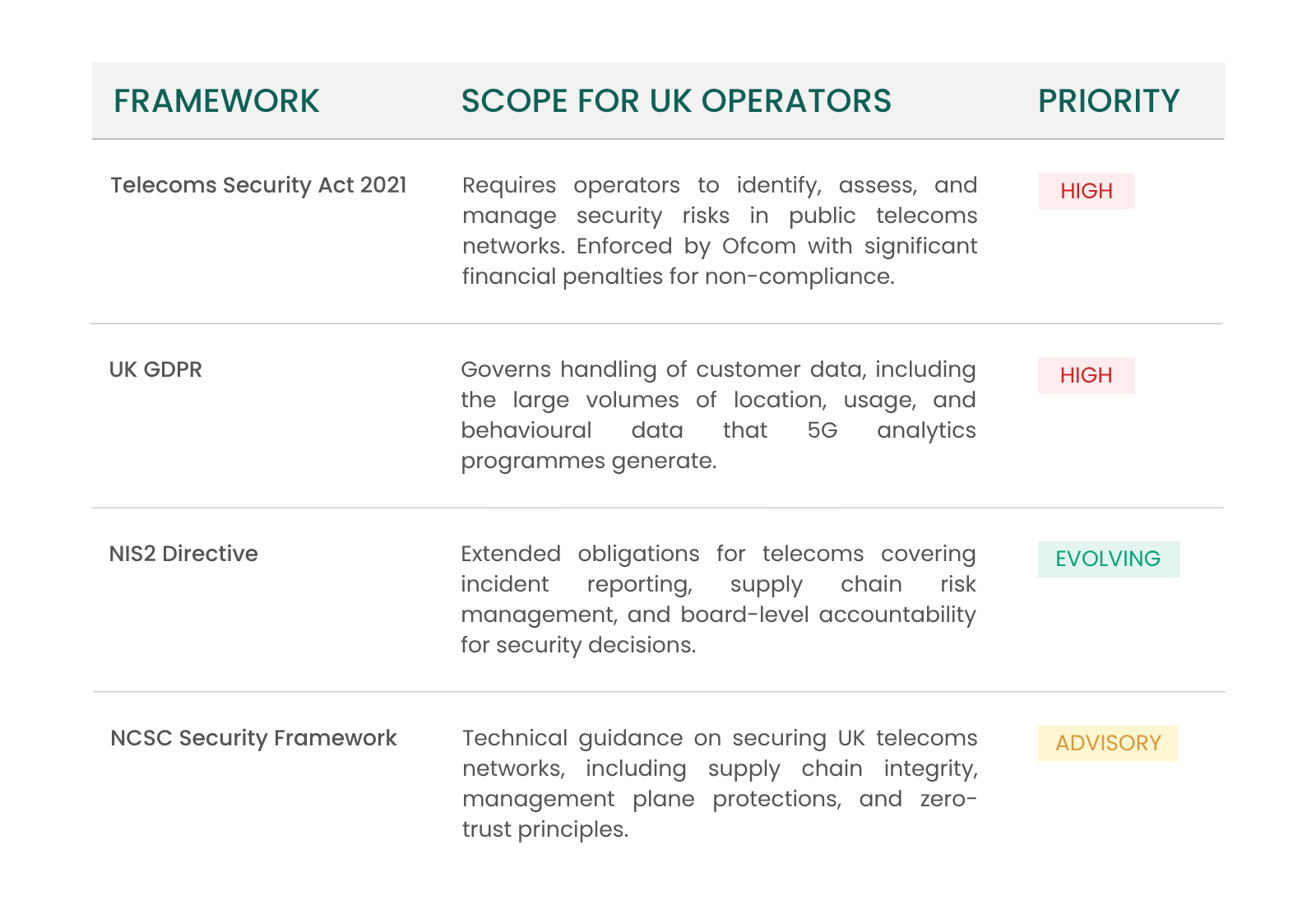
UK regulatory obligations for network operators
Security principles for 5G network environments
Zero-trust architecture has become the reference model for securing modern telecom environments. Rather than assuming that traffic inside the network perimeter is trustworthy, zero trust requires every request from every device, user, and service to be authenticated and authorised before access is granted.
The NCSC's security analysis of the UK telecoms sector identifies the management plane as the primary target for malicious actors, and highlights supply chain integrity as one of the highest-risk areas for network operators.[9] The most important principle remains embedding security from the outset of infrastructure design rather than retrofitting it later.
"The threats that dominated 2025 — APT campaigns, supply chain attacks, DDoS floods — aren't going away. The question is whether operators have built the resilience to absorb them."
Kaspersky Security Bulletin, December 2025
Cloud Migration Strategies for Telecom Providers in 2026
Navigating the transition without disrupting the services operators are built to deliver.
Cloud transformation is no longer an option for operators at scale. It is a prerequisite for the operational agility, data processing capability, and cost structure that modern network management requires. The question for most operators is not whether to migrate, but how to do so in a way that manages risk, maintains service continuity, and delivers tangible value at each phase of the journey.
Hybrid and multi-cloud approaches have become the standard model for telecom cloud migration. Critical and real-time network workloads may remain on private infrastructure or at the edge, while analytics platforms, BSS systems, and less latency-sensitive workloads move to public cloud environments. The result is an architecture that balances performance, resilience, and cost — though one that also introduces complexity in data governance, integration, and security management that requires careful planning.
Managing migration risk while maintaining service continuity is perhaps the most demanding aspect of telecom cloud programmes. Operators cannot afford unplanned downtime during migration, and the interdependencies between legacy systems are often poorly documented. Phased migration approaches, with clear rollback capabilities, extensive parallel running, and defined criteria for cutover, are essential for managing this risk in practice.
Ntegra's Cloud Centre of Excellence supports telecom organisations through every phase of cloud adoption, from initial strategy and architecture through to migration execution and ongoing optimisation. With experience across regulated, complex, and operationally critical environments, the team combines technical depth with the delivery discipline that programmes of this scale require.
A well-structured migration roadmap delivers early wins that demonstrate value and build organisational confidence, while managing the full complexity of the transformation in a structured, risk-aware way.
Ntegra is a technology delivery partner with deep experience in telecoms, OSS/BSS transformation, and cloud migration. Our teams have worked with operators including Vodafone, Connexin and Amdocs to design and deliver the infrastructure and integration programmes that modern network operations depend upon. To find out more, contact us or explore our Connexin case study and Cloud Centre of Excellence.
Frequently Asked Questions
What is telecom data analytics, and how is it used by network operators?
Telecom data analytics covers the collection, processing, and interpretation of data generated by network infrastructure, operational systems, and customer interactions. UK operators use it to monitor network performance, predict and prevent faults, plan capacity, and reduce churn. As 5G networks generate larger and more complex data streams, the role of analytics in day-to-day operations continues to grow.
What are the biggest challenges in 5G network infrastructure rollout?
5G rollout requires managing a more heterogeneous and distributed network architecture than previous generations, integrating new radio technologies alongside legacy infrastructure, and deploying dense small-cell networks at scale. In the UK, operators are also navigating spectrum coordination, security obligations under the Telecommunications (Security) Act 2021, and the commercial challenge of monetising new 5G services. Data analytics helps by enabling more precise planning, real-time monitoring, and evidence-based investment decisions throughout the rollout.
How can telecom operators improve cybersecurity in 5G environments?
Effective 5G cybersecurity starts at the architecture stage. Zero-trust network architecture, AI-powered threat detection, rigorous supply chain security management, and a compliance framework aligned to Ofcom, NIS2, and GDPR obligations are all essential components of a robust security posture. The NCSC provides detailed guidance for UK telecoms operators on managing the highest-risk areas of network security.
What is OSS/BSS, and why does modernisation matter?
Operational support systems (OSS) manage the technical operation of a telecoms network, while business support systems (BSS) handle billing, customer management, and order processing. Many UK operators run on legacy platforms not designed for the data volumes or integration demands of modern networks. Migrating to cloud-native architectures and connecting OSS and BSS through a shared data layer is a foundational step in building analytics-driven operations.
How does edge computing support telecom data analytics?
Edge computing allows data to be processed at or near the point where it is generated, within the access network rather than in a centralised data centre. For telecom analytics this reduces latency and bandwidth costs, and enables faster automated responses to network events. As 5G Standalone deployment accelerates across the UK, edge analytics capability will become increasingly central to operator performance.
