

Read Time:
5
Minutes
Design & User Experience
August 4, 2026
The Hidden Business Cost of Poor User Experience
Bad user experience may seem like a minor inconvenience, but across an organisation it can quietly drain productivity, increase errors and drive up operational costs. From wasted time to rising support tickets, the hidden impact of poor UX is far greater than most organisations realise. This article explores where those costs emerge and why a design-first approach is essential for successful digital transformation.
On the surface, at screen level, bad user experience (UX) looks like an inconvenience: slow workflows, confusing screens, minor frustrations or ugly screens that make you roll your eyes and sigh. But beneath the surface, these tiny fractures within the user’s experience can quickly lead to distrust, confusion and frustration. These are all emotions which lead to the person psychologically blacklisting the product or company within seconds of use.
These emotions matter. In today's digital environment, we have seamless applications that give us information instantaneously, so users often decide within seconds whether they trust a product. If that trust breaks down, they can choose to close the screen, delete the application and maybe even leave a review that significantly damages the company's reputation.
The truth is, bad UX can be expensive.
Here's where those hidden costs appear and how design-first companies like Ntegra try to avoid them.
Time Wasted is Money Lost
Every extra click, confusing label or unnecessary step compounds across hundreds or thousands of users.
If a workflow requires 30 seconds per task, and an employee completes it 20 times a day, that's 10 minutes lost per person per day. Consider over a year, it’s 40 hours lost per employee. Now multiply that by 500 employees, and you have 20,000 hours of productivity gone.
In other words, a misplaced button or unclear workflow might feel minor in isolation, but across an organisation, it snowballs exponentially. Without a structured discovery phase or someone to dig through heatmaps, analytics and data, the root cause remains hidden, only to surface and disrupt delivery later in the lifecycle.
This is why organisations involve digital consultancy services and subject matter experts earlier in delivery programmes – leading to my next point...
Error Cost > Time to Fix Them
Confusing interfaces inevitably lead to human error.
An incorrect data entry. Duplicated records. Missed screens in a banking application that result in incomplete forms.
Most people have experienced filling in a long form, making one mistake and being forced to start again. That frustration doesn't just lead to poor user experience but also to increased operational costs. Behind the scenes, development teams must search through code, audit for errors and resolve issues. In complex environments, fixing one problem can easily break another part of the system. For sectors such as government, finance, health and critical infrastructure, these issues extend beyond inconveniences to impact cost, productivity, reputation and sometimes even safety.
Industry research consistently shows that identifying issues early dramatically reduces costs. A defect caught in the design phase can be resolved at a fraction of the cost and time compared to one found after release, often 4-6 times cheaper than fixing it during development and up to 30-100 times cheaper than addressing it in production.
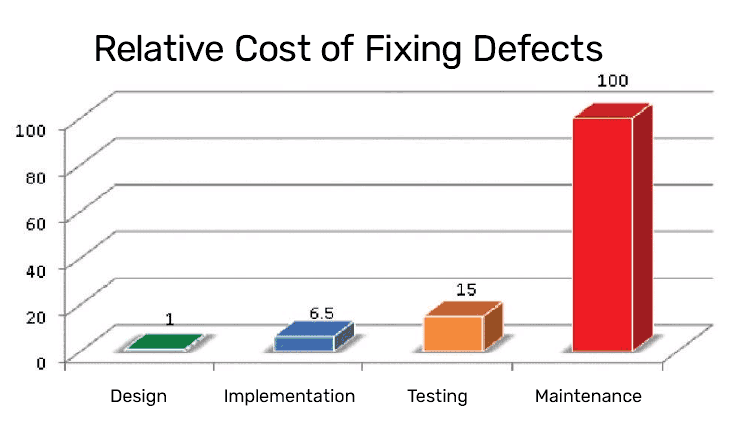
This is why Ntegra leverages modern product engineering practices and agile ways of working to help organisations prioritise design validation early in the process. Through rapid prototyping, usability testing and iterative design, our teams can identify friction points quickly and refine the user experience before development begins.
Leading to:
Lower delivery costs – issues resolved during design are far cheaper than fixes in development or production.
Faster time to value – teams avoid building the wrong features and move into development with greater clarity.
Reduced operational risk – validated workflows minimise post-launch errors, rework and disruption.
Higher user adoption – products designed around real user behaviour are easier to use and more widely adopted.
Fewer support demands – intuitive interfaces reduce helpdesk queries and ongoing operational overhead.
Support Tickets Skyrocket
When a system is hard to use, people ask for help.
Support desks become overloaded with questions that could have been avoided through better design.
Common patterns include:
· “Where do I find this?”
· “Why won’t this submit?”
· “What does this mean?”
· “Why is this error showing?”
Industry benchmarks show that 40–60% of support requests are caused by poor UX, unclear workflows, or misleading terminology. Without thoughtful design and thinking, organisations risk introducing complexity faster than they remove it.
Bad UX is silent and expensive.
Good UX, by contrast, is invisible with major impact.
That’s why design-first organisations embed user experience into their innovation pipeline from the earliest stages of delivery.
At Ntegra, the focus is on designing digital services with intention:
Reduce operational risk - Identify usability issues and workflow gaps early, preventing costly failures, errors and disruption after launch.
Eliminate friction in workflows - Simplify processes and interfaces so users can complete tasks intuitively without unnecessary steps or confusion.
Shorten time to complete tasks - Streamlined journeys reduce clicks, decisions and delays, improving productivity across teams and customers.
Increase user adoption - Well-designed products align with real user behaviour, encouraging engagement and reducing resistance to new systems.
Lower long-term cost and error rates - Clearer interfaces minimise mistakes, support requests and expensive rework throughout the product lifecycle.
This approach combines user-centred design with broader technical thinking, ensuring platforms, data and user experience evolve together as part of intelligent transformation.
Design isn’t about making something look ‘pretty’, even though we do this too! It’s about making something which functions seamlessly, appeals to the user, and delivers measurable value across the organisation.
If this is something you’re looking for, contact us today.
Cat Mellors | Product Design Lead at Ntegra
